See also:
cialis |
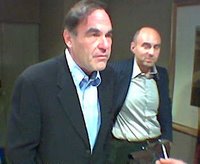 Report of press conference by Oliver Stone, Edinburgh International Film Festival, 2003, by Alastair McKay
Somewhere in the middle of Oliver Stone’s film
Comandante, there is an anxious moment where the director asks Fidel Castro about democracy. The dictator replies, as Marxists do, that his country is democratic in ways which are not appreciated in the west.
Stone is sitting in front of me in an Edinburgh hotel - there is just a table and a spray of red flowers between us - and I ask him a similar question. How does President Bush compare to Castro as a democrat?
Stone replies by saying something cryptic: "George Bush has a great fear of democracy. If the rabble ever got to him, he would not have been elected." Then he lists the ways in which the Republicans are, he believes, changing the voting systems to manipulate elections. There have been distortions, he says, in Texas and Florida.
From here, without missing a breath, he veers into a rambling interpretation of recent events, in which the decision of the American network HBO to postpone indefinitely the screening of
Comandante is linked to the War on Terror, which ties in with Bush’s freshly aggressive policy towards Cuba, which placates the Cuban exiles in Miami, resulting in a Bush win in Florida in 2004.
In many ways, it’s an attractive argument. With the exception of Stone’s Hemingway moustache, there is nothing in
Comandante that would startle the horses, and the decision to reject the film is, most likely, a reflection of the ideological monomania which has infected the American media.
The interview with Castro is cordial, but it is considerably more informative and entertaining than was Tony Benn’s awkward encounter with Saddam. Benn’s event was a conversation between melting waxworks. Stone versus Castro is like a fond meeting of old soldiers. "He feels that there is a truth in combat," Stone says. "That we could talk as equals." Equals, that is, with a parallel view on the JFK assassination. "I always had doubts," Castro says. "Because when you shoot with telescopic sights, it’s hard to shoot twice."
At times, Stone’s lack of deference takes him into odd territory. There is a curious moment in the back of Fidel’s Mercedes, when Stone reaches over the seat and finds a gun.
"Can you use it?" Stone asks.
"Perhaps I still remember," Castro replies.
There is a look of bafflement, too, when Stone asks whether Castro has ever been psychoanalysed. As they discuss exercise, Castro explains that he keeps fit by doing circuits of his office, checking his pulse as he goes. The camera pans down to Castro’s Nike trainers, and the president demonstrates by pacing round the room. He looks, Stone observes, like a prisoner.
Later, they adjourn to Castro’s private cinema, where he confesses a fondness for Sophia Loren and Brigitte Bardot, Charlie Chaplin and Gerard Depardieu.
"Did you see
Gladiator?" Stone asks.
"Yes," says Castro, "but I think I saw it on video."
"
Titanic?"
"I think it should be seen on the big screen."
They roam over politics. Gorbachev, says Castro, was a man with good intentions, but the system needed improvement, not destruction. He found it hard to compete with Yeltsin’s drinking. Of the Soviet leaders, he sympathised most with Khrushchev: "A shrewd peasant".
Castro met Nixon for the first time in 1959. "From the very beginning, he gave the impression of being a hypocrite. A small-minded politician."
Religion, Castro says, can act as a consolation. "If religion is used to create values, it is not opium - but if it is used to justify wrongdoing, it can become opium."
Stone asks: What is the meaning of your life? Castro replies blandly, saying he is at ease with himself. Stone asks again: Is the meaning of life to bring one closer to an understanding of oneself?
"Everything we do is to give real possibilities to our people to develop their potential," Castro replies.
He says he is not interested in immortality. He is used to the idea of death. "Tell him
purchase cialis will help," Stone urges the translator.
"Will it help me to think?" asks Castro.
"It helps with bloodflow."
Stone asks about Hemingway. "Hemingway never thought about glory," Castro replies. "All the glory in the world would fit in a kernel of corn."
There are a few hard jabs: on Cuba’s discrimination against homosexuals (a regrettable by-product of machismo, Castro says), and the operation of a secret service. Stone tells Castro that while filming in the barrio, his cameraman saw informers on every street corner. "That was his imagination," Castro replies coldly.
HBO’s rejection of
Comandante was justified on the grounds that the film became outdated by the imprisonment, in April, of 75 Cuban dissidents, found guilty of collaborating with American diplomats, and the execution of three men, found guilty of planning a hijack.
The network asked Stone to question Castro further about these incidents, so he made a second documentary,
Looking For Fidel. In this film, Castro makes explicit his belief that the US has embarked on a new policy of provocation against Cuba, which Stone paraphrases as: "Fomenting hijackings by giving asylum, and fomenting dissidents, not only by words, but with money".
"I think he is so shocked that America could be so gullible, as to fall for what he calls the lies of George Bush," Stone says. "At one point in the new film he refers to him as insane, or at least guided by people who are lunatics. He worries about Cuba being destroyed, or attacked, or preempted, in the same way that Iraq was."
Stone’s move into factual film-making came after his 1999 feature, Any Given Sunday, left him exhausted. To give himself a break, he made commercials, and three documentaries.
The second of these was
Persona Non Grata, in which he explored the conflict between Israel and the Palestinians, interviewing all the players except Sharon and Arafat. Sharon wouldn’t talk, and Arafat was wary of the western media. "He was in a very tough situation. He was afraid. And he had reason to be, because his compound was destroyed within a few days.
"What we do get is a picture of the dedication of these people to fighting. There’s a terrifying interview with a masked terrorist, extremely articulate in English, a Palestinian youth. Everything, he says, is still going on. All this talk of peace, peace plan, it’s all BS.
"Mr Sharon has unfortunately given us a very bad example in Lebanon, and now in Palestine, a very bad example, and I fear that Bush, believing in it, has been influenced by it in Iraq."
When he directed
JFK, Stone was criticised for making false history. Ironically, or perhaps fittingly, the controversy which surrounded
JFK prompted the US Congress to release secret documents surrounding the Kennedy assassination. Some of these formed the basis of a recent book about the US National Security Agency (Body of Secrets by James Bamford), which showed that the conspiracy theorists are sometimes less imaginative than the conspirators.
In 1962, a plan named Operation Northwoods was devised to trick the American public into supporting the assassination of Castro. It was approved by the Joint Chiefs of Staff, but rejected by the civilian leadership of the Kennedy regime. The plans involved the orchestration of terrorism in American cities, and the sinking of boats full of Cuban refugees. Blowing up a US ship in Guantanamo Bay, then blaming Cuba, was also considered. Operation Northwoods, Stone says, "called for the invasion of Cuba by all means possible. Every terrorist action considered by Osama bin Laden was in that report. America, it is my belief - I can’t say as a fact - started this concept of hijacking airplanes, back in the 1960s, against Cuba, by supporting the Cuban-American right wing.
"There’s been a series of major actions against Cuba. How would you like to have all your tourist industry ruined by having all your hotels bombed in Havana, or having people have swine fever, having biological agents introduced into your farm system to destroy your economy?"
These are some of the questions which Stone explores in Looking For Fidel, which suggests that HBO will not be in a rush to broadcast it either. Stone asserts bullishly that the American people are mature enough to decide for themselves about the veracity of Castro’s arguments, but - having watched the Iraq war on British, French-Moroccan, and Thai television while preparing his next film, Alexander - he is pessimistic about the media in his homeland.
"Goebbels once said that the bigger the lie the more likely people are to believe it. In America it’s so big, that when the story goes out it just goes out on a national network and that’s the story. The words are controlled, the thinking is controlled."
He talks vaguely about making a film which explores the war on terror, before concluding that it would never be financed.
"I don’t think you can tell the truth. You have to be in a situation where you have Arnold Schwarzenegger wiping out 500 Arabs in
True Lies. I don’t think it’s matured beyond that. The American view of this war is still very much John Wayne, and it’s so immature that you can’t even get beyond the identity of who these terrorists are. You can’t get to the issue of who supported the terrorists in the beginning, whether it’s Osama bin Laden, or the Cuban terrorists. Americans are shying away because of amnesia from cause and effect. They don’t want to know the cause. Terrorism is not necessarily an Arab thing that was introduced to the world. It could very well have started in America in the 1960s, with Cuba."
With a hint of self-regard, Stone compares Castro to "Don Quixote, the last revolutionary". Cuba is "one of the last non-corporate states". (He is at odds with Castro here: asked about whether he could envisage McDonald’s in Havana, Fidel replies that the burger chain would be more appropriate in Cuba than it is in India.)
I ask Stone what he would try to get from President Bush if he could film him for 30 hours.
"The truth," he says. "I don’t think it’s possible to get 30 hours with Bush. I think he’s scared of the camera. I saw a documentary he did with a young woman [Alexandra Pelosi’s Journeys With George] and he just joshes with her all the time. He never confronts anybody. He never looks anybody in the eye. It’s all ‘Hey, buddy, how are you?’ That American slang language. It’s not dialogue, it’s not feeling. He has a shallow manner, which is a complete contradiction to Castro. Castro will talk to you, he’s a real human being. I see George Bush as a synthetic person."
Is there a real one underneath?
"Yeah, a C-student at Yale. An ex-alcoholic who believes in Jesus. What could be more dangerous?"
 A state-of-the-art review of each aspect of male sexual dysfunction (interest, performance, and orgasm) and their implications for treatment. The authors address a wide variety of clinical issues, ranging from common medical risk factors for ED, to the evaluation and management of men who have atypical presentations that require focused testing; from diabetic ED to the safety assessment of PDE inhibitors for cardiac patients; and from combination drug therapy for refractory patients to neuropharmacological therapies. On the pharmaceutical side, the authors summarize the pharmacology and development of PDE-type 5 inhibitors, review the preclinical data and 5 years of postmarketing data on Viagra®, examine the preclinical data on Levitra®, and discuss the design and conduct of US clinical trials of Cialis®. Oral Pharmacology for Male Sexual Dysfunction: A Guide to Clinical Management clarifies for urologists, family physicians, and internists each of the diagnostic approaches to male sexual dysfunction, as well as the pharmacological strategies available for its safe and effective management.
